Nordstone Team
Professional Writers
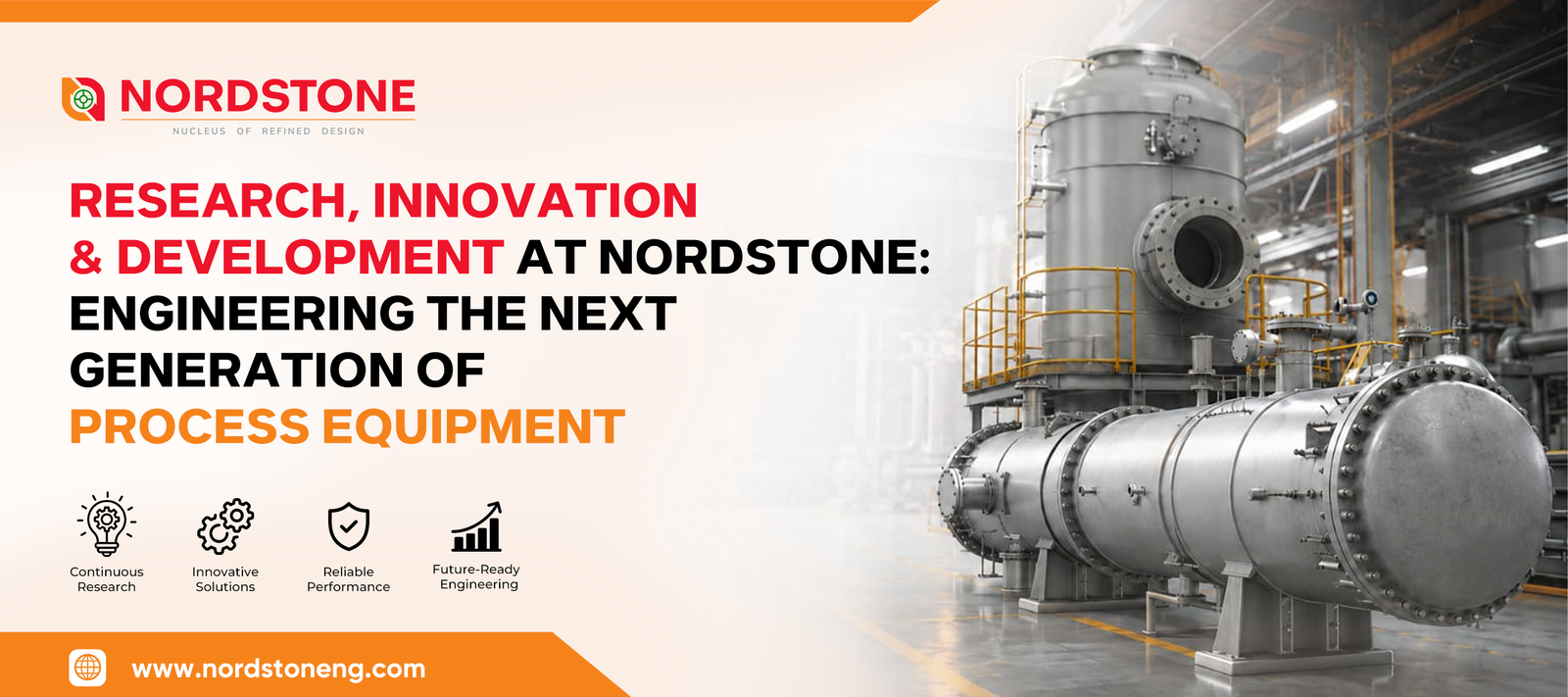
Research, Innovation & Development at Nordstone: Engineering the Next Generation of Process Equipment
Why R&D Matters in Process Equipment
Industrial process equipment may look simple from the outside, but its reliability depends on engineering decisions involving stress, temperature, materials, welding and process conditions.
At Nordstone Engineering & Design, research and development is integrated into the engineering process. Every project is an opportunity to improve design methods, validate simulations, evaluate materials and develop safer and more efficient solutions.
From pressure vessels and heat exchangers to reactors, columns, cryogenic systems and modular skids, our approach focuses on engineering performance from the earliest design stage.
Digital Simulation Before Steel Is Cut
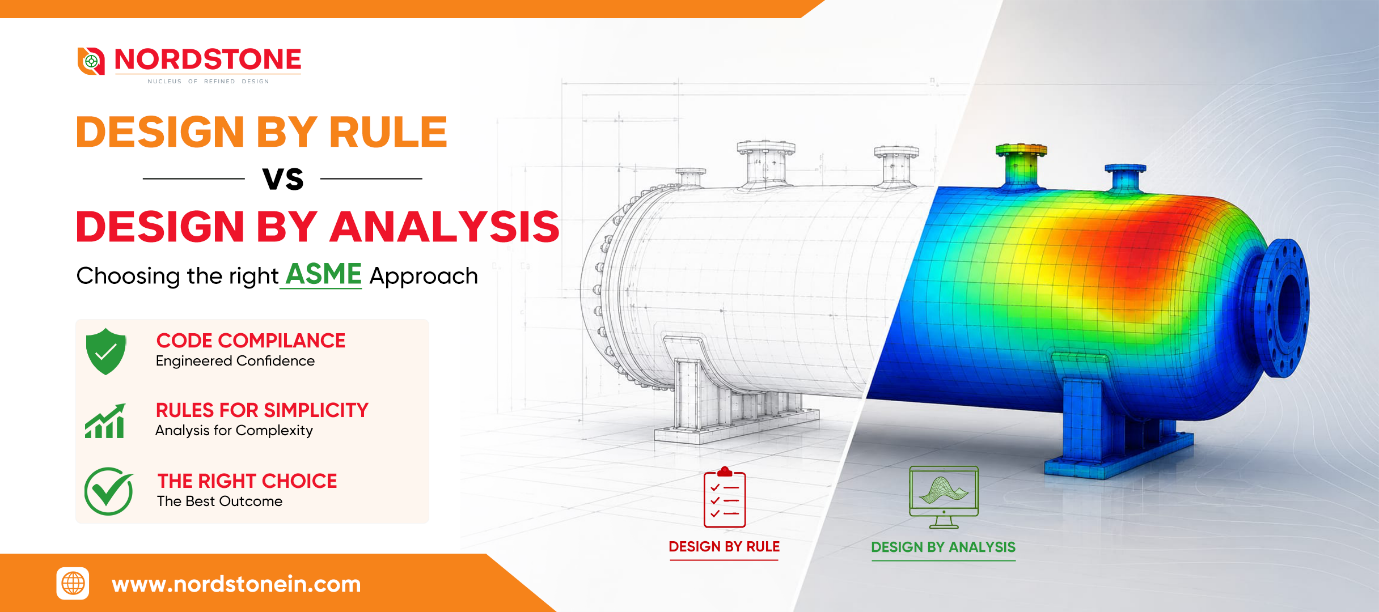
Modern process equipment engineering increasingly relies on digital simulation to validate designs before fabrication. This design-right-first-time approach helps identify potential problems early, reduce rework and improve equipment reliability.
Mechanical integrity can be evaluated using recognised standards such as ASME Section VIII Division 1 and Division 2, PED, IS 2825 and API 650/620. Engineering tools such as PV Elite and Compress support calculations for shell and head thickness, MAWP, MDMT, nozzle reinforcement and external loads.
Heat exchanger performance can be evaluated using HTRI and Aspen EDR, allowing engineers to study thermal duty, fouling, pressure drop and flow-induced vibration.
Finite Element Analysis using tools such as ANSYS provides deeper insight into stress concentrations, thermal stresses, fatigue, buckling and collapse behaviour. CFD can also be used to understand flow distribution, dead zones, pressure drop and erosion-prone regions.
Mechanical Integrity
Pressure, thickness and structural analysis.
Thermal Analysis
Heat duty, fouling and pressure drop.
FEA
Stress, fatigue and buckling analysis.
CFD
Fluid flow and process behaviour.
Materials Research for Extreme Service
Process equipment is increasingly required to operate under higher pressures, lower temperatures and more aggressive chemical conditions. Selecting the correct material is therefore a critical part of engineering development.
Advanced materials such as Super Duplex, Hastelloy and Titanium can provide improved corrosion resistance and performance in demanding applications. Material selection must also consider fabrication, welding, availability, inspection and lifecycle requirements.
Cryogenic applications introduce additional challenges, including thermal contraction and low-temperature toughness. Hydrogen service also requires careful consideration of hydrogen compatibility and potential embrittlement.
Welding research is equally important. Proper WPS, PQR and WPQ qualification helps ensure that welded joints provide the required strength and reliability, particularly when working with high-alloy or dissimilar materials.
Energy Efficiency and Decarbonisation
Process equipment has a direct influence on industrial energy consumption. Better engineering can help recover waste heat, reduce energy losses and improve plant efficiency.
Heat recovery systems and improved exchanger designs can recover energy that would otherwise be lost. Optimised thermal sizing can achieve the required duty without unnecessarily increasing equipment size, material consumption or pumping power.
Cryogenic systems benefit from improved insulation and heat ingress modelling, helping reduce boil-off losses. The growth of carbon capture technologies is also creating demand for specialised absorber, stripper and CO₂-handling equipment.
Heat Recovery
Recover useful energy from process streams.
Thermal Optimisation
Improve exchanger performance and efficiency.
Cryogenic Efficiency
Reduce heat ingress and product losses.
CCUS Equipment
Support carbon capture applications.
Modularisation and Process Skids
Modularisation is changing how process plants are designed and installed. Instead of assembling individual components at site, complete process units can be engineered, fabricated and tested as integrated packages.
A modular skid can combine vessels, pumps, heat exchangers, piping, valves, instrumentation, controls and structural frames into a single engineered unit.
This requires close coordination between process, mechanical, piping, structural, electrical and automation engineering. Equipment must also be designed for transportation, lifting, installation and operating loads.
PLC, SCADA, DCS, interlocks and Emergency Shutdown systems can be integrated from the beginning. Factory Acceptance Testing provides an additional opportunity to validate the complete package before it reaches the site.
Digital Documentation and Traceability
Engineering innovation is not limited to physical equipment. Complete and structured technical documentation is becoming an important part of modern asset management.
A complete equipment dossier may include PFDs, P&IDs, mechanical datasheets, design calculations, GA drawings, nozzle details, BOMs, welding records, ITPs, NDE reports, material certificates and inspection documentation.
Treating documentation as an engineered deliverable improves traceability, simplifies certification and provides the owner with valuable information throughout the equipment lifecycle.
Where Process Equipment Engineering Is Heading
Hydrogen
High-pressure and cryogenic systems.
CCUS
Equipment for carbon capture processes.
Digital Twins
Connecting equipment with digital models.
Advanced Manufacturing
More precise fabrication technologies.
Sustainability
Lower material and energy consumption.
The Nordstone Approach to R&D
At Nordstone Engineering & Design, research and development is closely connected to engineering execution. The objective is practical innovation that solves real engineering challenges.
Whether the goal is improving pressure vessel reliability, reducing equipment weight, optimising thermal performance, selecting advanced materials or developing modular systems, every improvement contributes to better equipment.
Design Right
Validate Through Simulation
Build With Quality
Document Completely
Engineering the Next Generation of Process Equipment
The process equipment industry is moving toward higher performance, greater efficiency and more digitally connected engineering workflows.
Pressure vessels must operate under demanding conditions. Heat exchangers must deliver greater efficiency. Materials must withstand increasingly aggressive environments, while modular systems must integrate more functions into compact packages.
Meeting these requirements requires more than traditional equipment design. It requires continuous research, practical innovation and disciplined engineering development.
At Nordstone Engineering & Design, our focus is on combining engineering analysis, simulation, materials expertise and quality manufacturing to develop reliable, efficient and future-ready process equipment.
Looking for Process Equipment Engineering Solutions?
From pressure vessels and heat exchangers to cryogenic systems, reactors, columns and modular process skids, Nordstone Engineering & Design supports demanding industrial engineering applications.
Explore Nordstone Engineering