Nordstone Team
Professional Writers
Design-by-Rule vs. Design-by-Analysis: Choosing the Right ASME Approach
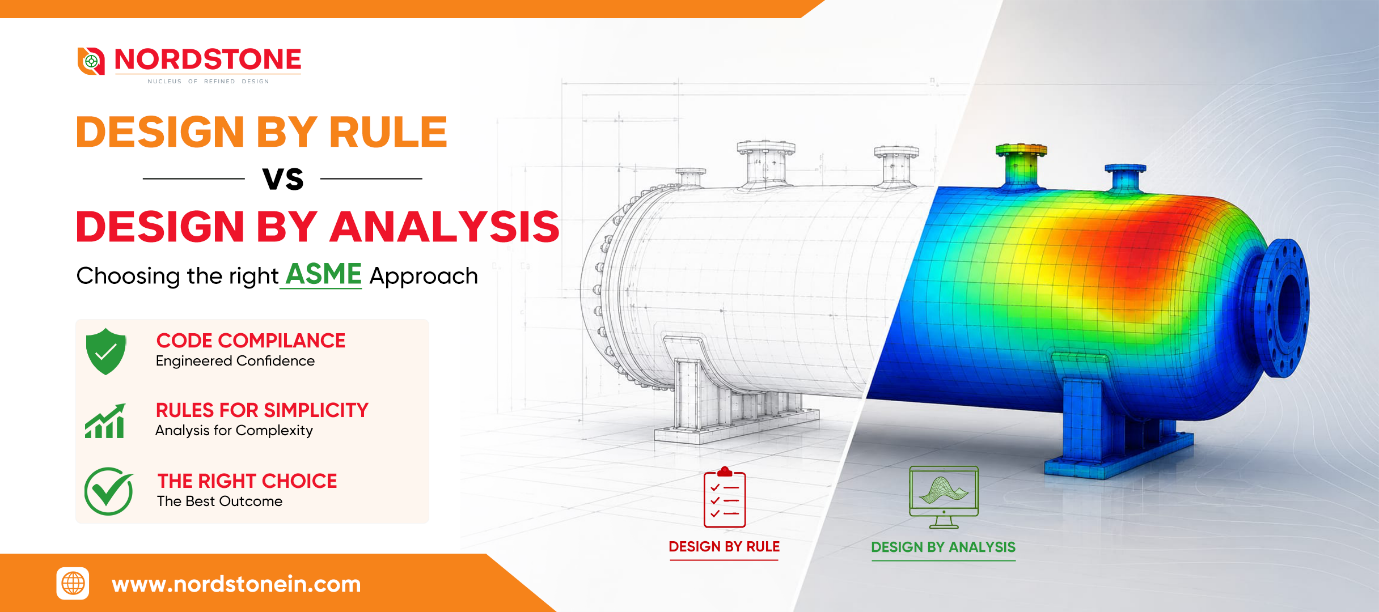
Pressure vessel design is a critical aspect of industrial safety, ensuring equipment can withstand internal pressure, external loads, and operating conditions throughout its service life. The ASME Boiler and Pressure Vessel Code (BPVC) Section VIII provides internationally recognized standards for designing pressure vessels. Within this code, Division 1 (Design by Rule) and Division 2 (Design by Analysis) are the two most commonly used approaches.
While both divisions aim to produce safe and reliable pressure vessels, they differ significantly in methodology, engineering effort, material utilization, and project cost. Understanding these differences helps manufacturers, EPC contractors, and plant owners choose the most suitable design approach for their application.
What is ASME Section VIII Division 1 (Design by Rule)?
ASME Section VIII Division 1 is the traditional and most widely used design method for pressure vessels. It follows a Design-by-Rule (DBR) philosophy, where engineers use predefined equations, conservative safety factors, and standardized formulas to determine the minimum required thickness of vessel components.
Key Characteristics
- Uses established design formulas from the ASME Code.
- Suitable for standard pressure vessel geometries.
- Simpler calculations with faster engineering turnaround.
- Widely accepted across industries.
- Lower engineering cost.
- Conservative wall thickness due to higher safety margins.
Typical Applications
Division 1 is commonly used for:
- Storage vessels
- Air receivers
- Heat exchangers
- Chemical process vessels
- Water treatment equipment
- General industrial pressure vessels
Because of its straightforward methodology, Division 1 is often the preferred choice for routine industrial applications where design optimization is not the primary objective.
What is ASME Section VIII Division 2 (Design by Analysis)?
ASME Section VIII Division 2 follows a Design-by-Analysis (DBA) approach. Instead of relying solely on empirical equations, engineers evaluate stresses, fatigue, buckling, local loads, and structural behavior using advanced engineering methods such as Finite Element Analysis (FEA).
Division 2 allows designers to understand how the vessel behaves under actual operating conditions, resulting in a more optimized and efficient design.
Key Characteristics
- Lower design safety factor compared to Division 1.
- Uses detailed stress analysis.
- Requires Finite Element Analysis (FEA) for many applications.
- Evaluates fatigue, cyclic loading, nozzle loads, wind, seismic, and thermal stresses.
- Enables thinner vessel walls while maintaining safety.
- Requires higher engineering expertise.
Typical Applications
Division 2 is commonly selected for:
- High-pressure vessels
- Large-diameter reactors
- Refinery equipment
- LNG applications
- Offshore platforms
- Nuclear support systems
- Heavy-wall vessels
- Custom-engineered process equipment
Where Division 2 Saves Weight, Material, and Cost
One of the biggest advantages of Division 2 is design optimization.
Since the design is based on actual stress analysis rather than conservative empirical formulas, engineers can reduce unnecessary material without compromising safety.
Benefits Include
- Reduced shell thickness
- Lower overall vessel weight
- Reduced steel consumption
- Lower fabrication costs
- Easier transportation
- Reduced foundation requirements
- Lower installation costs
- Better lifecycle efficiency
For large pressure vessels, these savings can be substantial. A reduction of even a few millimeters in wall thickness may translate into several tons of material savings, especially in heavy industrial projects.
Although the engineering phase is more expensive, the reduction in fabrication material often results in significant overall project savings.
The Added Engineering Effort Required for Division 2
The improved efficiency of Division 2 comes with increased engineering complexity.
Unlike Division 1, Division 2 requires engineers to perform detailed structural assessments that may include:
- Finite Element Analysis (FEA)
- Fatigue analysis
- Buckling evaluation
- Local stress analysis
- Thermal stress calculations
- Nozzle load assessment
- External load evaluation
- Cyclic service assessment
Additional requirements may include:
- More detailed material data
- Enhanced quality control
- Higher inspection requirements
- Comprehensive calculation reports
- Extensive documentation
As a result, Division 2 projects generally require experienced pressure vessel engineers and specialized engineering software.
How to Decide Which Division is Right for Your Pressure Vessel
Selecting the correct ASME division depends on several project factors.
Choose Division 1 When:
- Vessel geometry is relatively simple.
- Project schedules are tight.
- Engineering budget is limited.
- Material savings are minimal.
- Standard industrial equipment is sufficient.
- Regulatory requirements do not demand advanced analysis.
Choose Division 2 When:
- Material cost is high.
- Vessel dimensions are large.
- Weight reduction is important.
- High operating pressure exists.
- Complex nozzle arrangements are present.
- Fatigue loading is expected.
- Offshore or critical service applications are involved.
- Transportation weight limitations apply.
A lifecycle cost analysis often reveals that Division 2 becomes increasingly economical as vessel size and complexity increase.
Documentation and Certification Differences
Another major distinction between the two divisions is the level of engineering documentation required.
Division 1 Documentation
Typically includes:
- Design calculations
- Material certificates
- Welding procedure specifications
- Inspection records
- Hydrostatic test reports
- Manufacturer's Data Report
Division 2 Documentation
In addition to the above, Division 2 generally requires:
- Detailed stress analysis reports
- Finite Element Analysis documentation
- Fatigue assessment reports
- Buckling verification
- Load combination analysis
- Design validation records
- Enhanced inspection documentation
- More comprehensive quality assurance records
Because of the increased analytical requirements, certification and review processes are often more rigorous for Division 2 vessels.
Final Thoughts
Both ASME Section VIII Division 1 and Division 2 are proven methodologies for designing safe pressure vessels. The best choice depends on the vessel's size, operating conditions, budget, and project objectives.
If simplicity, faster turnaround, and lower engineering costs are the priorities, Division 1 remains the industry standard. However, for large, high-pressure, or weight-sensitive applications, Division 2 offers significant advantages through optimized material usage, improved structural efficiency, and long-term cost savings.
Choosing the right design approach early in a project can improve fabrication efficiency, reduce lifecycle costs, and ensure compliance with international pressure vessel standards. Working with experienced pressure vessel engineers and following the appropriate ASME Code requirements will help achieve a safe, reliable, and economically optimized design.